Is that community photograph current? Check the context
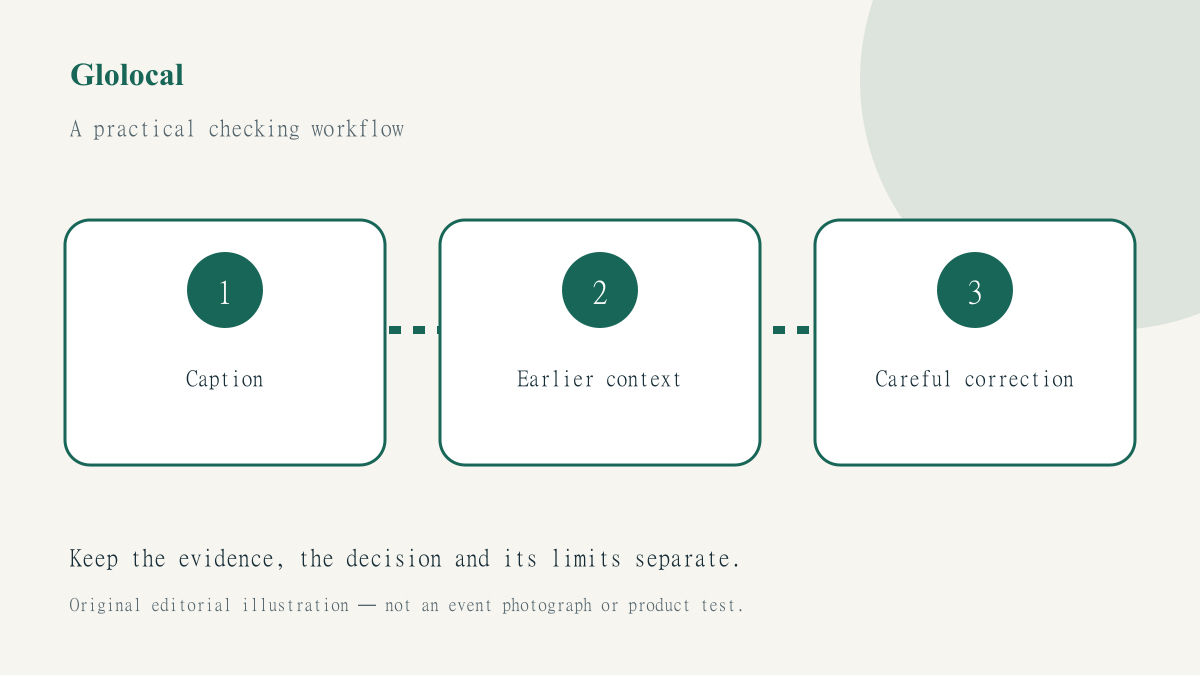
A dramatic local photograph can make an uncertain message feel immediate. A flooded road, a crowd outside a venue or a damaged building may be real, yet belong to another date or place. Before sharing it as a current community update, separate the image from the claim attached to it and consider what evidence would establish each detail.
The news-photo context guide provides the general method. This edition focuses on the practical effect of image reuse in local groups, where a familiar-looking scene can influence travel or attendance decisions. The examples below are hypothetical and do not describe a current incident.
Ask what the message actually says
Write down the claimed location, event and date. A caption saying near the market may not identify which market, and a reference to this morning may be meaningless after several forwards. If the claim is too vague to test, ask for the original public source or withhold a conclusion. Familiarity is a reason to investigate, not a substitute for evidence.
Preserve the original page link, caption and visible publication time where available. Do not expose private group members’ identities simply to demonstrate that a message circulated. The checking task concerns the image and its claim, not an assumption about the motives of every person who passed it along.
Look for the fuller image and caption
A crop may hide a distinctive building, photographer credit or notice explaining the event. Compare the complete image where possible and look for earlier appearances through a suitable reverse-image tool. Open the matching pages rather than drawing a conclusion from search thumbnails alone. Similar scenes can produce visually similar results without depicting the same photograph.
Record what an earlier appearance establishes. It may show that the picture was online before the claimed current incident, but the page date is not necessarily the camera’s original timestamp. Keep image reuse, event date and location as separate questions. Precision makes a correction more useful and reduces the chance of replacing one unsupported claim with another.
Trace the source of the reporting
A community page, news aggregator and publisher report can repeat the same picture and caption. Understanding how an aggregator differs from a publisher helps identify which destination may contain the original reporting. Repetition alone should not be mistaken for independent verification.
Use the coverage comparison workflow to follow attribution when several reports appear to agree. Look for the responsible organiser, an original photographer or current reporting from the claimed place. A map-like visual resemblance or one matching sign can narrow the inquiry without settling it by itself.
Keep urgent practical advice tied to responsible sources
If a picture appears to concern immediate danger or disrupted access, use current instructions from the relevant responsible service rather than offering your own safety verdict based on the image. This guide is not emergency reporting. An unverified photo should not become a reason to advise people that a route is safe, a building is open or an incident is over.
For ordinary plans, identify what the recipient actually needs to decide. Someone travelling to a venue may need a current access notice, not a definitive history of every copy of a photograph. Link to the best current responsible information and explain any remaining uncertainty. Avoid making a dramatic image the centre of a practical update when it adds no verified detail.
Publish a correction that does not repeat the mistake
For a group moderator, keep a small correction record with the original claim, the evidence located, the amended wording and the person maintaining the notice. Link the correction from the original controlled post where possible. A separate correction that nobody reading the old message can find may leave the practical misunderstanding unchanged.
State the supported finding plainly: an earlier page contains the same image, a caption identifies another event, or the claim remains unverified. Include the evidence link where appropriate. Do not label a picture fake merely because its date is wrong; it may be an authentic photograph used misleadingly. Avoid accusations about a person’s intent without evidence.
Explore attributed reports through NewsBeagle, then apply the checks to the particular image rather than relying on the number of places it appears. Our corrections contact provides a route for concerns about our own guides. A good community correction gives readers a better decision record without creating another unsupported story to circulate.