Check a forwarded local notice before acting on it
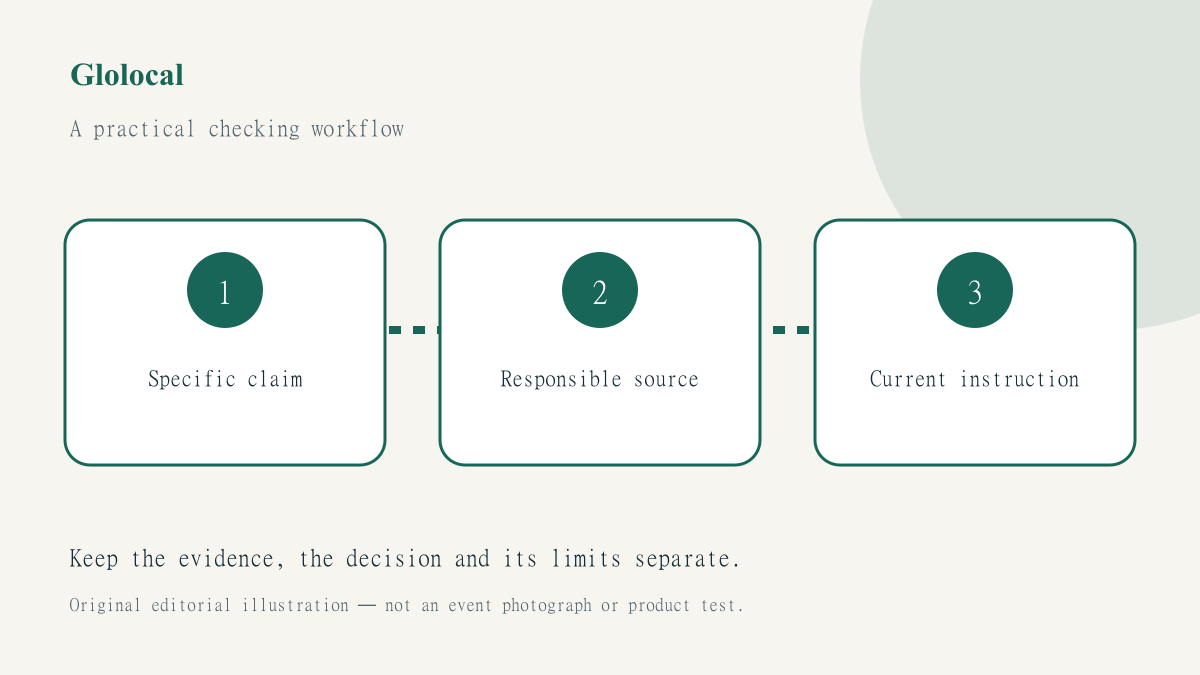
A forwarded local notice can spread faster than the page it came from. By the time it reaches a neighbourhood conversation, the source link may be missing and a statement about one road, venue or date may sound like a wider instruction. Before acting on it or passing it on, reconstruct the specific claim and the route back to whoever is responsible for the information.
The explanation of news aggregators and publishers is useful here. A service or group that helps you discover a notice has not necessarily verified it. This article proposes a checking routine for an ordinary community update; it does not describe an actual current closure, emergency or official instruction.
Write down the claim in separate parts
Identify the place, activity, date, affected people and requested action. A notice may concern one entrance rather than a whole building, or one day’s opening hours rather than a permanent change. Keep those details separate so that a familiar place name does not make an unrelated instruction appear relevant to your own plans.
Preserve the message’s original wording and any visible source information where you are authorised to do so. Avoid publishing private group members’ details as part of the check. If the notice contains personal information, use the minimum necessary context when seeking clarification. Verification should not create a new privacy problem for people who happened to forward the message.
Find the responsible source
Look for the organiser, venue, public body or service provider that would actually make the decision described. Use its genuine website or established contact route rather than a number introduced by an unverified message. A copied logo or official-looking format is not enough to establish who issued a notice.
The coverage-comparison method helps when several articles repeat the same statement. Trace their attribution. Three local pages copying one announcement may provide useful distribution, but do not become three independent confirmations. A later update from the responsible source can matter more than several older reposts.
Check the local date and the current version
Words such as today, tomorrow and this weekend lose their meaning when a screenshot is shared later. Translate them into the actual calendar date supported by the source. Check the publication date, any meaningful update note and whether the notice still applies. Do not assume that a page recently shared by a neighbour was recently published by its author.
Where the place has several branches or similarly named locations, compare the exact address or area. A correct notice for one venue can be misleading when applied to another. If the source does not resolve the ambiguity, retain an unverified status and explain the specific detail that still needs confirmation instead of circulating an overconfident interpretation.
Investigate accompanying pictures separately
An image can make a notice feel current without actually documenting it. Use the photo-context checklist if the picture’s date or location matters. Preserve its caption and source page. A photograph showing a real queue, damaged road or closed door does not by itself establish the date claimed by the new message.
If you cannot verify the picture, consider whether the text can be explained without republishing it. Avoid attaching an uncertain image to a corrected notice, because readers may remember the dramatic picture more strongly than the qualification below it. Keep the text’s evidence and the image’s evidence as separate decisions.
Share the correction with a bounded conclusion
Keep a simple change log on the maintained notice: which field changed, the supporting source and the actual update time. This is particularly useful when opening hours and access arrangements are confirmed by different people. A reader should not need to compare several old screenshots to work out which instruction is currently intended.
A useful follow-up identifies the original claim, links to the current responsible source and explains the particular correction. State what remains unresolved. For example, a source might establish the new opening date while leaving access arrangements to a separate venue contact. Do not turn one verified detail into a guarantee about everything a reader may need.
Use NewsBeagle for attributed coverage discovery, while preserving the route back to the original reporting or notice. Our editorial policy follows the same distinction. Helpful community sharing is not a competition to be first; it is a way to give neighbours a clearer basis for deciding what to do next.